Post ideas · HVAC · by season
34 HVAC social media post ideas, one season at a time
Every idea is the post as it would read on the feed plus the one reason it gets saved, grouped by the weather your customers are about to feel, with an emergency block for the weeks the forecast rewrites the calendar.
Post the problem one season before the customer feels it: the AC first-run post in the first warm week of April, the furnace post in September, the ice-on-the-heat-pump post before the first cold snap. The 34 ideas below are grouped that way, spring (7), summer (7), fall (7), winter (7) and emergencies (6), each as the hook the post opens with and the reason it works.
Northwind Heating & Air
Demo brand
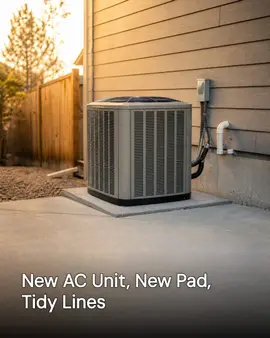
Summer idea seven, the new unit on its pad, as the generator produced it. Real generator output for Northwind Heating & Air, a demo brand we built ourselves to show a trade we have no customer in yet.
How to read this calendar
Every idea on this page is two lines. The hook is the post as it would read on the feed, close enough to paste into a caption box tonight with your own numbers in it. The why is the mechanism underneath: the reason that post gets saved, sent to a neighbour or acted on, so you can write the next one yourself when the season turns.
The timing rule is the one the intro named. Post the problem one season early, because in the week the customer feels it they are searching, not scrolling, and the post that was already on your page is the one they find. If your service area has no real winter, fold the winter group into fall and stretch summer across the extra months; the groups are named by weather events rather than months for exactly that reason.
Spring: the first hot week (7 ideas)
The customer has not touched the cool setting since October. These seven land in the week they first do.
Turned the AC on for the first time since October and it smells like burnt dust? That is six months of it on the coil, and it clears in ten minutes. These two sounds do not, and they mean a call.
Why it works Nearly every homeowner in your area has this exact first-run moment inside the same seven-day window, so the post is saved the week it lands and sent to the neighbour who asked the same thing.
This is the capacitor meter reading on a tune-up. 38 on a part rated 45 means the compressor is working harder than it should, and it will quit on the first 95 degree day.
Why it works A reading on a real meter turns tune-up from a sales word into a thing the customer can picture, and the number gives the caption something a stock photo never has.
Setting the thermostat to 78 while you are at work does not make the house cool down faster when you get home. It runs longer, that is all. Here is what setback actually saves in a month.
Why it works It settles the argument every household has in May, and a post that settles a household argument gets tagged to the other half of it.
Pull the leaves, the cottonwood fluff and the dryer lint off the outdoor unit before the first hot week. Shut the power off at the disconnect first. Thirty seconds, and the coil can breathe again.
Why it works A job the customer can do themselves reads as help rather than a pitch, and the disconnect line shows the company thinks about their safety before the sale.
Yes, the old refrigerant is gone and the replacement costs more. No, your system does not need topping off every spring. If it is low it is leaking, and topping off a leak is renting the refrigerant.
Why it works The refrigerant question is the one homeowners are most afraid of being lied to about, and answering it plainly before they ask is the fastest trust a company earns on a feed.
A maintenance agreement is two visits a year, a filter each time, priority scheduling when the whole street calls at once, and a discount on parts. Here is what it costs, and here is what it does not cover.
Why it works Agreements are the steadiest money in the trade and the least explained thing on most HVAC pages, and the does-not-cover line is what makes the post read as an offer instead of a pitch.
Every tune-up slot before June 1 is on the calendar now. After the first 90 degree day the wait is ten days, and ten days is when systems fail.
Why it works A dated, capacity-shaped offer is a fact rather than a promotion, and it gives the follower a reason to book this week instead of the week their AC quits.
Summer: peak cooling (7 ideas)
The phones are already ringing. These seven are for the weeks you have the least time to post and the most to show.
Left: the filter we pulled from a house whose upstairs would not get below 80. Right: the one we put in. Ninety days apart. That is the whole diagnosis.
Why it works A clogged filter beside a clean one is the most understood image in the trade, and it is the one post a tech can shoot on any maintenance call in July.
Northwind Heating & Air
Demo brand

Idea one as a finished post: the filter that choked in July. Real generator output for Northwind Heating & Air, a demo brand we built ourselves to show a trade we have no customer in yet.
Why is upstairs ten degrees hotter than downstairs? Heat rises, the return is downstairs, and the ducts to the second floor are the longest run in the house. Three fixes, cheapest first.
Why it works It names the exact complaint the customer already typed into a search bar, and the cheapest-first order signals the company is not leading with a new system.
Attic reading at 2pm today: 137 degrees. This is where your ductwork lives. Every seam that leaks up here is cooled air you paid for going into the insulation.
Why it works The number on the thermometer, on camera, in a real attic, is proof of a problem the customer cannot see and the reason for the duct-sealing quote that arrives later.
The wet spot on the ceiling under the air handler is not a roof leak. It is a clogged condensate line, and it backs up on the hottest day because that is when the system makes the most water.
Why it works It intercepts a call that would have gone to a roofer, and explaining why it happens on the worst day makes the company sound like it has seen this a hundred times.
The question we got most last week: why is my AC running all day and never shutting off? Our lead tech answers it in sixty seconds, from the driveway.
Why it works A tech on camera answering last week's most common question is a post the company can repeat every week of the season without it ever reading as repeated.
Before you call us on a 100 degree day, try these four: thermostat on cool and set below room temperature, the breaker, the filter, and whether the outdoor fan is turning. Two of the four fix it a third of the time.
Why it works A checklist that talks a follower out of an unnecessary service call is the strongest trust post in the trade, and it is remembered on the day the checklist does not work.
Old unit on the curb, new unit on the pad. Eighteen years, one refrigerant change and a lot of tape. Same afternoon, lines run clean.
Why it works The dead unit tells the story the shiny one cannot, and a pair shot with the age of what came out is what another homeowner with an eighteen-year-old system studies.
Fall: before the first cold night (7 ideas)
Posted in September while the furnace is still off, when a homeowner can still choose the date instead of taking the next one.
Before the first cold night: thermostat to heat, new filter in, vents open, furnace switch on, and stand by it through the first cycle. Ten minutes of dust smell is normal. Any smell of gas is not, and you call from outside.
Why it works It is the same first-run moment as spring on the other system, and the gas line gives the post a safety weight a tune-up reminder does not carry.
This is a camera going into a heat exchanger. A crack in here is how carbon monoxide gets into the air you breathe, and you cannot see it from the outside of the furnace.
Why it works Showing the inspection camera turns an abstract safety claim into a procedure with a picture, and it explains why a furnace check is not a two-minute glance.
Where your CO detector should not be: beside the furnace, behind a curtain, or on the garage ceiling. Where it should be: outside every bedroom, between knee and chest height, tested this week.
Why it works A placement post is useful whether or not the follower ever hires the company, and useful-without-buying is what earns a share on a neighbourhood page.
Your smart thermostat has been running a cooling schedule since May. Tonight, switch it to the heating one: 68 when you are home, 62 overnight, and let it learn from there.
Why it works It turns an installed product into a twice-a-year habit, which gives the company a reason to post about a thermostat in both seasons rather than once at install.
Northwind Heating & Air
Demo brand

Idea four as a finished post: the thermostat, mounted and waiting for its heating schedule. Real generator output for Northwind Heating & Air, a demo brand we built ourselves to show a trade we have no customer in yet.
Nosebleeds, static shocks and a wood floor that starts to gap in October are one problem: the furnace dries the house to 20 percent humidity. A whole-home humidifier holds it at 40.
Why it works It names symptoms the customer blames on winter, connects them to the system, and introduces an add-on without the word upsell anywhere near it.
If your heat pump is steaming in the cold, it is defrosting itself. Ice forms on the outdoor coil, the unit reverses for a few minutes to melt it, and it will do that all winter. Not a leak, not a fire.
Why it works Heat pumps are new to most of the homeowners who have one, and the first defrost cycle produces a panic call the company can prevent with one post.
This is the last mild week to book a furnace inspection on a day you choose. After the first freeze, no-heat calls come first and inspections wait behind them.
Why it works The honest reason for booking early, said in the customer's interest, lands better than a discount because it is still true on the day they read it.
Winter: deep heating season (7 ideas)
The system runs every day now, and every post is read by somebody whose house is either warm or not.
No heat at 2am: check the thermostat batteries, the furnace switch (it looks like a light switch, near the unit), the breaker, and the filter. If none of those, stop there and call. Do not open the burner compartment.
Why it works The stop-there line is the point: a post that tells the follower where the safe checks end is the post they trust with the unsafe ones.
Ice on the heat pump: a coat of frost is normal. A solid block over the whole coil is not, and it usually means the defrost cycle has failed. Switch to emergency heat and call.
Why it works Two photos, one normal and one not, hand the customer a way to tell the difference themselves, which is why this one gets saved rather than scrolled past.
Frozen pipes are a plumber's job. What we can do in a cold snap: get a dead furnace running, check that heat is reaching the rooms the pipes run through, and set up temporary heat while a part comes in.
Why it works Saying what the company will not do, in the sentence before what it will, reads as the voice of a company that will not oversell on the phone either.
Furnace kicking on, running two minutes, shutting off, and doing it again all evening? That is short-cycling. Usually a dirty flame sensor, sometimes an oversized furnace, and it wears the igniter out either way.
Why it works It names a symptom the homeowner has noticed but has no word for, and handing them the word is the moment the company becomes the one they call.
Yes, this is the filter reminder again. Your furnace has run every day for eight weeks, and that is the same filter that was rated for ninety days back in September.
Why it works Repeating the reminder on purpose, and saying so, is what makes it land: the follower who ignored it in September does the arithmetic on eight weeks.
Rooftop unit, four inches of snow, 9 degrees. The access panel has to come off up here whether or not it is pleasant. This is what a commercial no-heat call looks like.
Why it works A tech on a roof in the snow is the picture of the work itself, and it is the post that finds the property manager who has never seen the company's name.
Northwind Heating & Air
Demo brand
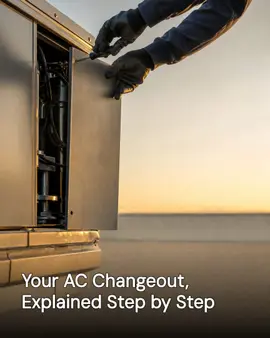
Idea six as a finished post: the rooftop package unit with the panel about to come off. Real generator output for Northwind Heating & Air, a demo brand we built ourselves to show a trade we have no customer in yet.
The bedroom over the garage is always 8 degrees colder and always will be, because the ductwork ends before it does. A ductless mini-split heats that one room without touching the rest of the house.
Why it works It sells the mini-split as the answer to one named room rather than as a product, which is how homeowners actually decide to buy one.
Emergencies: heat waves, cold snaps, and outages (6 ideas)
For the mornings the forecast changes the week: a heat advisory, a cold snap, a storm, an outage. Each of these reads as help because it costs the reader nothing and asks for nothing.
Heat advisory from noon Thursday. If your system is going to fail this summer, this is the week. Three things to do this morning: new filter, thermostat set and left alone, outdoor unit cleared.
Why it works Posted the morning the advisory is issued, it reads as a heads-up from somebody who watches the forecast for a living, and nobody reads it as a sale.
Straight answer: we are booked solid until Thursday. If your AC is out, here is what to do meanwhile: fans, blinds shut on the sun side, one room on the coolest floor, and the cooling-centre address if anyone in the house is over 70.
Why it works The honest capacity post turns a no on the phone into a company the caller comes back to, because it helped on the day it could not sell.
Power is back. Before you touch the thermostat, give it five minutes, then set it to cool, then wait. A compressor started three times in a minute after an outage is how an outage turns into a replacement.
Why it works The restart sequence prevents a real failure at the exact hour the customer is about to cause it, which is the most concrete help a feed can give.
Cold snap tonight. If the furnace is running hard, so is the risk: test the CO detector today, keep snow off the exhaust pipe on the side of the house, and never run a generator in the garage.
Why it works It pairs the CO reminder with the weather event that makes it urgent, and the generator line is the one that gets shared on the night the power goes.
After the storm: walk around the outdoor unit. Branches in the fan, hail dents in the fins, standing water at the base. Send us the photo before you switch it back on.
Why it works An invitation to send a photo is a low-stakes way to start a conversation, and it puts the company in a homeowner's hand at the moment of a real problem.
Our prices during a heat wave are the same prices as in April. The wait is longer. The invoice is not.
Why it works Saying out loud that emergency pricing does not change removes the one suspicion every caller has during a heat wave, and it is the line that makes the rest of the block read as help.
How often to post, by season
Practical counts from the trade's calendar, not targets. The last row is the free plan on this site, stated as the floor a shop can hold in any season.
| Season | Image posts a week | Short videos a week | Cross-posts | Lead with | Skip |
|---|---|---|---|---|---|
| Spring | 3 | 1 | 1 | The first-run post and the tune-up with the meter in shot | Anything about the furnace, it is over for now |
| Summer | 3 to 4 | 1 to 2 | 1 | The filter pair and the tech answering last week's question | Long explainers nobody reads at 95 degrees |
| Fall | 3 | 1 | 1 | The first cold night checklist and the heat exchanger camera | Cooling content of any kind after mid-September |
| Winter | 2 to 3 | 1 | 1 | The safe no-heat checks and the short-cycling explainer | New-system pitches in a week the town has no heat |
| Emergency weeks | 1 a day for the event | 0 to 1 | The advisory post, to Google Business Profile | The booked-until-Thursday post and the restart sequence | Anything scheduled before the forecast changed that now reads wrong |
| Free plan floor | 3 | 1 | 1 | Whatever the season row above says to lead with | Nothing, this row is the floor a shop can hold all year |
Turn a season into a scheduled week
SpeedRun Social reads your website into a brand kit, then writes the caption and generates the image or short video for each post in your company's voice, with a season's ideas as the brief. Every post waits in an approval queue until somebody at the shop taps approve, and the approved week schedules itself to Instagram, Facebook, LinkedIn, X (Twitter), TikTok, YouTube, Threads, Pinterest, Bluesky, Google Business Profile, and WordPress.
The free plan is 300 credits a month and one free campaign a week (3 posts, 1 video, 1 cross-post) to start, then free with no end date for light use, no card, watermarked media on free. Paid plans are $49.99, $99.99 and $199.99 a month.
No account, no email, no card. One post from your own website.
Questions HVAC companies ask about social media
What should an HVAC company post on social media?
Post the problem the customer is about to have, one season early: the first-run smell in April, the clogged filter in July, the heat exchanger camera in September, the safe no-heat checks in January. Add the work itself, old unit on the curb and new unit on the pad, and a tech answering last week's most common question. The 34 ideas above are that list, grouped by season.
How often should an HVAC company post on Facebook and Instagram?
Three image posts, one short video and one cross-post a week is a floor a two-truck shop can hold all year, and the free plan here starts you on it. Go to four or five posts in peak cooling and heating weeks, when you have the most to show, and drop to two or three in the shoulder months rather than going quiet. The cadence table above gives the split.
What do we post in the slow season when nothing is breaking?
The slow season is when the posts get made, not skipped. In the mild weeks explain the system: what a tune-up checks, why a maintenance agreement costs what it does, where the CO detector goes, how the smart thermostat schedule works. Photograph the changeouts and filter pairs you had no time to post in July and run them now. Slow weeks suit the ideas that need a minute to read.
Do we need different posts for heating season and cooling season?
Yes, and the switch should happen a few weeks before the weather does. Cooling posts are about the outdoor unit, the filter, the attic and the condensate line; heating posts are about the heat exchanger, carbon monoxide, short-cycling and the heat pump's defrost cycle. A furnace post in July gets scrolled past by the same person who saves it in September. The four seasonal groups above are that split.
How do we post during a heat wave or cold snap without looking like we are cashing in?
Post help that costs the reader nothing: the restart sequence after an outage, the four checks before calling, the cooling-centre line for anyone over 70, the CO reminder on a cold night. Say plainly how booked you are and what to do meanwhile. Then say, in one line, that your prices are the same as they were in April. Nobody reads that block as a sale.
Which platform matters most for an HVAC company, Facebook or Instagram?
Facebook for the phone calls, Instagram for the pictures. Recommendations get asked for in neighbourhood groups on Facebook, so that is where the emergency block and the checklists belong. Instagram is where the changeout pairs and the attic video earn a following. Post the same ideas to both, and put the Google Business Profile ahead of either for a furnace search at midnight.
What does the free plan include?
300 credits a month and one free campaign a week (3 posts, 1 video, 1 cross-post) to start, then free with no end date for light use, no card, watermarked media on free. Each campaign is written and illustrated from your own website and waits in the approval queue until somebody at the shop releases it. Nothing publishes on its own until you turn approval off.
Keep reading
- Social media marketing for HVAC pros, the product page
- Best social media tools for HVAC companies, ranked
- Mistakes HVAC companies make on social media
- Landscaping social media post ideas
- Free caption generator with an HVAC preset
- Post ideas for plumbing companies
- plumbing social media post ideas
- Post ideas for electricians, by job type
- Google Business Profile post ideas