Social media automation for small service businesses
A service business sells labor and time, not shelf stock, so the thing worth automating is not a content calendar. It is the trip from a phone photo taken on a jobsite to a finished post on the profile a customer checks at six in the morning with water on the floor. Here is what that looks like in practice, and where it should stop.
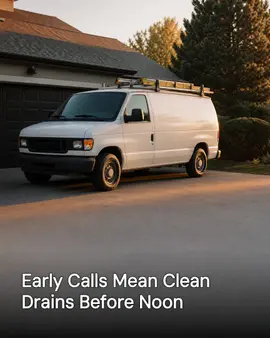
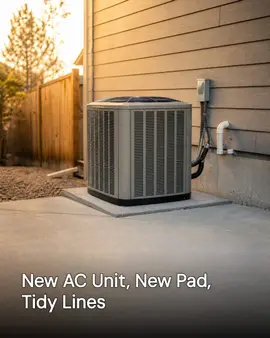
What a jobsite photo turns into
Copperline Plumbing
Demo brand
Northwind Heating & Air
Demo brand
Front Range Lawn & Turf
Demo brand

Real generator output. All three cards are marked "Demo brand", businesses we built ourselves to show trades we have no customer in yet. None of it is stock photography, and none of it is a mockup.
Why the usual social media advice does not fit
Almost every guide to this is written for a business with a product to photograph and somebody at a desk to photograph it. Six things are different when you sell labor.
The work is invisible by the time it is finished
A shop photographs the thing it sells. A service company sells a repaired line, a cleared drain, a tuned furnace, a cut lawn. Most of that is behind drywall or under grass within the hour, and the rest looks like nothing is wrong anymore. The unit of content is the job: what was broken, what you did, what it looks like now.
Nobody is at a desk when the good photo happens
The person standing over the finished work has dirty hands and a truck to load. Any process that begins with sitting down to write is a process that does not run in July. It has to begin with one photo and one sentence typed with a thumb, and everything after that is somebody else's job or a machine's.
Your busiest weeks are your quietest weeks online
Demand for service is shaped by weather and season. The month you most need the phone to ring is the month you have time to post, and the month you have plenty to show is the month you are working fourteen hour days. The point of automating any of this is to move the writing out of the busy week and into the slow one.
You sell a radius, not a shelf
Coverage is geographic. The only people worth reaching are inside your drive time, and the profile that decides whether they call is usually the map listing rather than the follower count. Naming the towns you cover is not keyword stuffing here. It is the literal answer to the question the customer is asking.
The buyer is not browsing, the buyer has a problem
Nobody scrolls looking for a plumber the way they scroll looking for shoes. They search in a panic, open two profiles, and pick the one that looks alive and local. The date on your last post is doing more work in that moment than the design of it, which is the whole argument for a queue that never runs dry.
Your reviews are the proof, and replying is a public act
For a service company the review page is the testimonial wall, and a reply is read by the next person deciding whether to call. That makes replying a form of publishing. It is also the one part of this that should never leave a machine and reach a customer without a person having read every word of it.
What to automate, and what to leave alone
The line is not about effort. It is about who carries the consequence when a sentence is wrong.
Automate
- Drafting a caption from a photo and one sentence about what the job was.
- Reshaping one idea for each network, instead of pasting the same block of text into five boxes.
- Scheduling, so a post lands on a weekday morning rather than at eleven at night when you finally sat down.
- The seasonal set you write once and run every year: freeze warnings, spring startup, fall tune ups, storm prep.
- Cross posting to the map listing, the page, and the feed from a single approval.
- The nudge that tells you the queue is nearly empty before it is empty.
Keep human
- Anything specific about a named customer, an address, or a property you worked on.
- Prices, quotes, warranty terms, and anything a reader could later hold you to.
- Review replies. A generated apology to an unhappy customer reads exactly like what it is.
- Outage and emergency messaging, where being wrong in public is far worse than being quiet.
- Code and safety claims. If a caption states how something should be installed, somebody licensed should have read it.
- The final approval. Every post in this workflow should be read by a person before it publishes.
Set it up in six steps
This works with any tool, including none. It is the order that matters.
Pick the five jobs you want more of
Write down the five services with the best margin or the most repeat work. Not everything you do, the five you want the phone to ring about. Everything downstream is built from that list, and it is the difference between posting about your company and posting about the work somebody is already searching for.
Give the crew one capture habit
One photo before, one photo after, one sentence about what was wrong. That is the entire ask. Put it on the job checklist so it happens at the truck instead of from memory on Friday. A phone photo of your own finished work beats a stock image of somebody else's pipe every single time.
Write down your service area and your season map
List the towns you cover, then list what the calendar does to your phone: the frozen line months, the dead month, the week everybody books a tune up. That one page is what lets a queue be built in February for June, which is the only way the busy season ever gets covered.
Draft a week, then draft the next one
A useful week is three posts built on real jobs, one short video, and one longer piece answering a question customers keep asking. Then you do it again. A month drafted in one sitting reads like a month drafted in one sitting, and half the jobs it describes have not happened yet.
Put one approval slot in the week and defend it
Fifteen minutes, on a phone, in a truck. Read the drafts, fix the two captions that got a detail wrong, kill the one about a customer who would not want it, approve the rest. If approval has no slot in the week it becomes the thing that does not happen, and a queue nobody approves is a queue that stops.
Publish to the map listing first
For most service companies Google Business Profile is where the decision to call gets made, then the Facebook page, then Instagram. Post there first and treat the others as the same idea in a different shape. Then leave it alone for a while and look at which of your five jobs actually produced calls.
What you need before you start
None of this is software. Gather it once and the first week takes an afternoon instead of a month of stalling.
- The five jobs you want more of, written down
- Two photos and one sentence from each job worth showing
- Your service area as a list of towns
- Whoever holds the Google Business Profile login
- A season map: the busy months, the dead month, the weather that moves your phone
- Fifteen minutes a week for approvals
Where this goes wrong
Six failure modes that show up over and over in the trades, in rough order of how much damage they do.
Posting only when work is slow
The gap is visible to anyone who scrolls. A burst in January and silence until March reads as a company that might not be there anymore, which is the opposite of what somebody with a burst pipe is checking for.
Letting a tool post about a job it does not know the facts of
Generated copy will confidently invent a detail about a repair. Your name is on the truck and the customer lives on that street, so a person has to read it before it goes out.
Photographing only the finished work
The before photo is the one that explains why anybody should call you. Without it, the after is a picture of a clean wall that could have come from anywhere.
Automating the review reply
Customers can tell, and so can the people reading the review afterwards. A generic reply to a specific complaint does more damage than no reply at all.
Chasing followers instead of the listing
A follower count does not book a job. Recency, photos of real work, honest service categories, and a complete map listing do.
Writing for other contractors
Trade language reads as expertise to your peers and as noise to a homeowner. Say what broke, what you did, and what it costs them if they wait.
The same week, trade by trade
The shape above holds across the service trades, but what you photograph and when you are free to post do not.
Plumbing companies
The job is the content, and almost all of it disappears behind a wall ten minutes after you finish. The plumbing page covers what to photograph and what a week built on drain and water heater work looks like.
Writing the posts yourself? Start with the plumbing social media ideas.
Dental practices
A service business where the most obvious content is the one thing you cannot casually post. The dental page covers keeping a calendar full without putting a patient's face online.
Writing the posts yourself? Start with the Dental Facebook post ideas.
Pest control companies
Prevention posts timed to ant, wasp, and mouse season, built from the photos worth showing while the infestation shots stay off the feed.
Writing the posts yourself? Start with the Pest control social media post ideas.
Chiropractic clinics
For the clinic whose patients lapse without saying so: education posts that promise nothing, a steady weekly cadence, and a feed the recall list still scrolls.
Writing the posts yourself? Start with the Chiropractic social media post ideas.
Comparing tools rather than reading about the workflow? The Blaze AI comparison and the Predis AI comparison list the questions worth asking any of them, and nine automation tools ranked for service businesses sets them beside each other with a price and a check date on every one. If your business is not a trade, the wider AI social media manager for small business page covers the same ground without assuming a jobsite, and the FAQ covers how SpeedRun Social works in detail.
Questions service companies ask
What should a service business actually automate?
The repeatable parts: drafting a caption from a job photo, reshaping one idea for each network, scheduling it for a sensible hour, and running the seasonal set you write once and reuse every year. What should stay with a person is anything specific to a named customer or property, anything a reader could hold you to such as a price or a warranty term, review replies, and the final approval on every post.
How often should a service company post?
We are not going to invent a number that holds for a two truck shop and a fifteen truck shop. What matters more than frequency is that the gap is never long enough to read as a company that closed. As a shape to start from, a week of three posts built on real jobs, one short video, and one longer piece answering a common question is enough to keep a profile current, and it is the size of the campaign SpeedRun Social includes free every week.
All our photos are phone photos from a jobsite. Is that a problem?
No, that is the input this is designed around. A phone photo of your own finished work is more convincing to a homeowner than a polished stock image, because it looks like the work they are about to buy. SpeedRun Social generates images built around the photos you upload, and setup can import photography already on your website.
Can it post to Google Business Profile?
Yes. You can connect Instagram, Facebook, LinkedIn, X (Twitter), TikTok, YouTube, Threads, Pinterest, Bluesky, Google Business Profile, and WordPress. One schedule can publish to all of them, which matters for a service company because the map listing is usually where the decision to call gets made.
Will it get the details of a specific job right?
Treat every caption as a draft. Copy is generated from your brand kit and from what you tell it about the job, and it does not know what actually happened in that crawl space. That is exactly why every post waits in an approval queue until somebody signs off. On a job you did for a customer who lives on that street, that step is the point.
What does it cost to try?
The free plan costs nothing and does not ask for a card. It includes 300 credits a month and one free campaign a week, which is three image posts, one short video, and one cross-post. Media generated on the free plan carries a small watermark. Paid plans add credits and remove the watermark, and you can cancel at any time.
See a week built from your own jobs
Connect your website, upload a few jobsite photos, and read the week it drafts before anything publishes. The free plan takes no card.