Post ideas, sorted by job

15 electrician social media posts, grouped by the job that made them

Every idea below is a script: what to shoot before the work, during it, and when it is done, plus the one line to write under it. Five jobs, three posts each, and a formula at the end for the jobs this page does not list.

Most electrical work disappears the moment it is finished. The wire goes into the wall, the breaker goes behind the cover, and the room looks the way it did last week, so the feed stops the day the job closes. Posting by job, while the job is still open, is the fix; this page is fifteen posts sorted that way.

Read it in the order your week runs. Panel change Tuesday, start at post one. Truck booked for chargers, skip to four. Each script names three moments worth ten seconds of your phone; each caption is written so you can swap the nouns and send it.

What each job gives you to post

JobThe one shot before the truck leavesThe post it becomes
Panel upgradeThe old panel, cover off, the moment you open it, before a breaker moves.A before-and-after pair that explains the invoice better than the estimate did.
EV charger installThe charger lit on the garage wall at dusk, car plugged in, shot from the driveway.The post a homeowner shopping for a charger saves, because it shows the finish.
Generator installThe first test run: unit running outside, house lights on, street dark behind.A calm proof post that shows what the machine is for, no storm mentioned.
Lighting jobThe room from one doorway twice, before the first fixture and after the last.The one electrical post where the after photo wins alone.
Service callThe failed part in your hand, next to the new one, on the tailgate.A small honest post: how long the call took, and that it was fixable.

Panel upgrades (posts 1 to 3)

The worst after photo and the best before photo. Nobody admires a closed panel; everybody looks inside the old one.

  1. The double-tapped breaker you found on arrival

    Before
    Cover off, phone level, one shot straight into the old panel before you touch or tidy anything.
    During
    A close shot of the two conductors under one lug, with a driver pointing at the second one.
    After
    The same lug with one conductor on it, from the angle of the first photo, so the pair explains itself.

    Caption

    Two circuits sharing one breaker. Found it during a panel check today, separated them, and each one has its own now.
  2. Dead front off, directory written

    Before
    The old directory card as you found it, pencil and tape and half the slots blank, flat against the panel.
    During
    Ten seconds of you or the apprentice writing the new directory with the panel open beside it.
    After
    The finished directory beside the combed conductors, lit with a work light across the panel instead of the flash.

    Caption

    Every breaker in this panel now says what it feeds. Twenty minutes, and the next electrician in here will thank us.

  3. The inspection sticker and the sentence for the owner

    Before
    The permit on the panel or window, close enough to read the word permit and nothing else.
    During
    The inspector's flashlight in the panel, or your final torque pass if they would rather not be filmed.
    After
    The passed sticker on the closed cover, the one time a closed panel is the photo.

    Caption

    Passed inspection this afternoon. The owner asked what the sticker means: a second licensed set of eyes agreed with ours.

EV charger installs (posts 4 to 6)

The job homeowners are searching for, and the one install that photographs like a product. Show what they cannot picture: everything between panel and plug.

  1. The load calculation, in plain words

    Before
    The panel label with the main breaker rating visible, next to the sheet or app where you ran the numbers.
    During
    One sentence on camera about why this house can take a forty-amp circuit and the one next door cannot.
    After
    The new breaker in the panel, labeled for the charger, directory updated to match.

    Caption

    Before a charger goes on the wall we add up what the house already draws. This one had room for a forty-amp circuit, no service upgrade needed.

  2. The conduit run and the breaker

    Before
    The bare wall with tape marking the path, shot wide from the garage door so the whole distance fits.
    During
    A close clip of a bend going in, or the run strapped at even intervals; straight conduit gets the comments.
    After
    The finished run from the same wide angle, panel to charger box, then a close shot of the disconnect or breaker.

    Caption

    Panel to charger, thirty-two feet of conduit, every strap where the code says it goes. The part nobody sees once the car is parked.

  3. The charger lit at dusk

    Before
    The empty spot on the wall where the charger will hang, shot from where the driver's door opens.
    During
    The charger mounted and the cover going on, or better, the owner's hand plugging in the first time.
    After
    Low light, from the driveway, charger lit and car plugged in; say what it took and how long.

    Caption

    Level 2 charger on the wall by six, car charging by half past. One day on site, one new circuit, no more stopping for gas.

Generator installs (posts 7 to 9)

A storm-adjacent job that does not have to be storm content. Nobody follows a feed that warns them weekly. Show the machine going in properly; the reader remembers their own last outage.

  1. The pad and the transfer switch before the unit arrives

    Before
    The patch of ground beside the house where the pad will go, gas meter or propane tank in frame.
    During
    The pad set and level, then the transfer switch mounted beside the panel with nothing connected yet.
    After
    The empty pad and the finished switch together, a rare after photo with no generator in it yet.

    Caption

    Pad poured, transfer switch mounted, conduit run. The generator arrives Thursday, and by then the hard part is done.

  2. Set day, from the curb

    Before
    The crate on the trailer at the curb, early, before the crew has unstrapped it, wide enough to show the size.
    During
    The lift onto the pad, whether by crane, machine, or four people and a bar, with the phone rolling before it starts.
    After
    The unit on the pad with the lines connected and the cover closed, shot low from the corner so it looks solid.

    Caption

    Set day. Four hundred pounds of standby generator, one careful lift, dead center on the pad we poured last week.

  3. The first test run with the house lights on

    Before
    The house from the street at dusk with the lights off, from the exact spot you will stand for the after.
    During
    The generator starting under a simulated outage and the transfer switch clicking over, with the audio left on.
    After
    The same view with every light on and the generator running in the side yard; the pair needs almost no caption.

    Caption

    Killed the main, the generator woke up, and the house never noticed. First test run done, the owner watching from the kitchen.

Two of these, finished

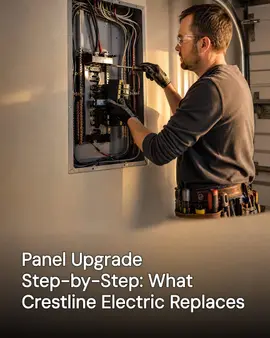
Nine scripts in, here is what one looks like once it is a post. The first card is real generator output for a demo brand; the second is post six written out in full, with no image, because we have not generated one for it.

Crestline Electric Co

Demo brand

Generated post: electrician tightening breakers in an open panel, headline about a Crestline panel upgrade baked into the image

Crestline Electric Co Open panel, labeled circuits, torque-tested connections. That's what a clean upgrade looks like before we close it up and call it done.

Generated

Written example, no image

Post 6, finished: the charger lit at dusk

Level 2 charger on the garage wall by six, car charging by half past.

One day on site. One new forty-amp circuit, thirty-two feet of conduit, every strap where the code puts it.

Thinking about a charger? Send us a photo of your panel and we will tell you whether the house has room before anyone quotes.

The left card is marked "Demo brand": a business we built ourselves to show the trade, with the headline baked into the image by the generator. It is not a customer. The right card is prose, written for this page, and is labelled as a written example so nobody mistakes it for output.

Lighting jobs (posts 10 to 12)

The one electrical job whose result is visible across a room. The least writing, the most discipline about framing: the after only works from the spot of the before.

  1. Under-cabinet run, same framing twice

    Before
    The counter from the doorway, overheads on, cabinets throwing a shadow on the backsplash; note where you stood.
    During
    The strip or puck going in under the first cabinet, wire path visible before the trim hides it.
    After
    The same doorway at the same time of evening, overheads off and under-cabinet lights on, shadow line gone.

    Caption

    Same kitchen, same doorway, eight feet of light under the cabinets. The shadow that made the counter feel dark is gone.

  2. Recessed cans mid-install

    Before
    The ceiling with the layout marked in pencil or tape, shot from the floor with the whole grid in frame.
    During
    The hole saw going through the drywall, or the first can pushed up and clipped, dust and all.
    After
    The finished ceiling with every can trimmed and lit, from the floor spot of the layout photo.

    Caption

    Six cans, one afternoon, and a living room that finally has light where people sit. This morning's pencil grid is the ceiling now.

  3. The exterior fixture at dusk, from the street

    Before
    The front of the house in daylight with the old fixture, or the bare box where one used to be, from the sidewalk.
    During
    The new fixture being mounted, the box sealed, or the photocell aimed, plus a clip of it coming on.
    After
    The same sidewalk spot at dusk with the fixture lit and the walk visible; the best photo you take all year.

    Caption

    New fixture over the front door, on a photocell so it comes on by itself. Shot from the sidewalk ten minutes after sunset.

Safety and service calls (posts 13 to 15)

The small and frightening jobs, posted without selling fear. Name the problem, name the cause, show the fix, and let the calm tone do the selling.

  1. The wobbling fan, fixed in twenty minutes

    Before
    A three-second clip of the fan wobbling on its old box, shot from directly below.
    During
    The old plastic box coming down and the fan-rated brace going in, the part nobody knew existed.
    After
    The fan on high from the same spot below, perfectly still, so the caption only names the fix.

    Caption

    Fan wobble is almost never the fan. This one hung on a box not rated for it; a brace went in, and it runs on high without moving.

  2. The outlet that ran hot

    Before
    The outlet cover with the brown scorch mark still in place, close enough to see the mark on a normal wall.
    During
    The back of the old receptacle in a gloved hand, showing the loose backstab connection behind the heat.
    After
    The new receptacle with the conductors on the side screws and your hand flat on the cover.

    Caption

    This outlet was warm to the touch. The cause was a loose connection on the back of it, not the wiring in the wall. New receptacle, wired properly.

  3. The smoke and CO detector swap, dated

    Before
    The old detector with its manufacture date visible on the back, beside your phone showing today's date.
    During
    The new unit twisting onto its base and the test button pressed, chirp left in the recording.
    After
    Every detector in the house on one counter, dated in marker on the base before they go up.

    Caption

    Ten-year detectors, dated on the base before they went up. If yours have no date on them, they are older than you think.

The caption formula every one of these uses

Four lines. Fill them for any job and the caption is done; here they are filled once with the panel upgrade so the shape is not abstract.

  1. What we found
  2. What we did
  3. Why the owner never thinks about it again
  4. One line in the owner's words
  1. Two circuits sharing one breaker, and a directory card with half the slots blank.
  2. Separated the double tap onto its own breaker, torqued every lug, wrote a directory the owner can read.
  3. Each circuit trips on its own now, and the next person in this panel knows what every breaker feeds.
  4. "I did not know a panel could look organized."

Making the week without a marketing hire

Fifteen scripts are a lot of captions to write between jobs. SpeedRun Social reads your website into a brand kit, writes each platform's caption in your voice, generates the image around your shot, and books the week. Every post waits for your approval. The free plan is 300 credits a month refilled forever, one free campaign a week (3 posts, 1 video, 1 cross-post), no card, watermarked media on free. Paid plans are $49.99, $99.99 and $199.99 a month.

The photos still have to be taken by the person holding the driver. What the tool takes off your evening is the writing, the scheduling, and the good photo stuck in the camera roll because nobody had a sentence for it.

Questions electricians ask about posting

  • What should an electrician post on social media?

    The job you did this week, shot while it was open. Panel upgrades give you a before-and-after that explains the invoice. EV chargers photograph like a product. Generators give you set day and the first test run. Lighting gives you an after photo that works alone. Service calls give you a small problem, calmly fixed.

  • How often should an electrician post?

    Two or three posts a week, at a pace you can hold from the truck. One job shot at three moments covers the week, since the before, the during and the after can each run on their own day. If you would rather hand the writing over, the free plan is 300 credits a month refilled forever, one free campaign a week (3 posts, 1 video, 1 cross-post), no card, watermarked media on free.

  • Can I post photos of a customer's panel or the inside of their house?

    Ask first, every time, and take a no without argument. Most owners say yes when the shot is the panel, the fixture or the conduit run rather than their belongings. Keep house numbers, mail and family photos out of frame, and never post a permit with a legible address.

  • What do I write in the caption for a panel upgrade?

    Use the four-line formula on this page: what you found, what you did, why the owner never thinks about it again, and one line in the owner's words. For a panel: the double tap, the new breaker and directory, each circuit tripping on its own, and what the owner said when they saw it.

  • Do I need to make videos, or are photos enough?

    Photos are enough for most of the fifteen. Video earns its place where motion or sound is the point: a fan wobbling and then still, a transfer switch clicking over, a charger lighting up. Ten seconds, no narration. Skip video entirely and you still have twelve of these fifteen.

  • Which matters more for an electrician, Facebook, Instagram, or Google Business Profile?

    Google Business Profile first, because a homeowner with a dead circuit is already looking there, next to your reviews. Facebook second, because local groups and recommendations still run there for the trades. Instagram third, for the lighting and charger photos. One photo and caption can serve all three.

  • Is it okay to post the scary stuff we find on service calls?

    Yes, if the post is about the fix and not the fear. Name what you found, name the cause in plain words, and show it repaired. A scorched receptacle captioned with its cause and its fix reads as competence; the same photo with a warning reads as a sales tactic. Leave out the owner's name and address, and if the hazard is still there, it is not a post yet.

Shoot one job this week, three times

Pick the job already on the schedule, take the before, the during and the after, and let the captions be written for you. Every post waits for your approval until you switch that off.