Guide · Plumbing

Social media for plumbing companies: 15 posts keyed to the problems you fix

Fifteen posts organised by the thing that is wrong in the homeowner's house, each with the photo to take on the job and a caption to paste. A three-post quick start first, a weekly-versus-monthly table after.

Start with these three this week

A plumbing company should post the problems it fixes, one at a time: the slow drain, the failed water heater, the leak behind the wall, the remodel rough-in, the frozen line. Each post is one job photo and two or three sentences on what went wrong and what fixed it, four times a week, on Google Business Profile and Facebook first.

  1. One drain job

    The photo
    The cable machine staged on a drop cloth in front of the open sink cabinet, tools laid out beside it. Shoot square-on at counter height, before anything gets wet.
    The caption
    Kitchen drain that had slowed to a trickle over about a year. Cable machine, fifty feet of line, grease and coffee grounds the whole way. No chemicals went down this sink: drain cleaner sits in a slow line and eats the pipe, not the clog. If your kitchen sink takes longer to empty than it did last spring, that is the drain telling you something.
  2. One water heater

    The photo
    The old tank on the hand truck next to the new one strapped in and flued, shot from the garage door so both fit. Wipe the lens first; garages are dark and a smudge turns everything grey.
    The caption
    Fourteen-year-old tank out, new one in, strapped and vented, done before lunch. The old one had a rusted-through bottom seam and had been quietly dripping into the pan for months. Look at the date on the sticker on yours. Past ten years, budget for it. Past twelve, plan for it.
  3. One crew shot

    The photo
    Two techs at the tailgate at the end of the day, tools half loaded, van doors open, the customer's house out of frame. A clean shot at 4pm beats a perfect one you never take.
    The caption
    Two of our techs at the end of a long Tuesday: a main line, two water heaters and a leaking angle stop that turned into a whole new shutoff. Put their first names here; if a homeowner has called you this year, one of these two probably showed up at the door. We hire slowly and we keep people. That is most of what a good plumbing company is.

Why the problem comes before the post

Nobody searches for a plumber. They search for the thing that is wrong: the kitchen sink that will not drain, the shower that went cold, the brown ring spreading across the dining room ceiling. When they find you, the feed they scroll is the interview. A feed organised by content category (tips Tuesday, team Thursday, a meme on Friday) answers none of their question; a feed organised by their problem answers it before they call.

So every post below is built the same way: the problem a homeowner would type, the photo you take on the job to prove you have fixed it before, and a caption you can paste and adjust. The photo comes first on purpose. A caption without a picture is a claim; a picture of the root mass on the tailgate is evidence. Write the caption the way you explain the job on the phone, and stop when you would stop.

One rule before any of it goes online. Photograph the work, not the house. No house numbers, no mail on the counter, no faces, no street names, and nothing wider than the cabinet or the wall you opened without the homeowner's permission in writing. A text message counts; assuming counts for nothing. Most homeowners are glad to have the job shown if you ask.

Drain problems: 3 posts

The most searched plumbing problem and the one with the best photos, because what comes out of a drain is something nobody else will show them.

  1. The kitchen drain that slowed down over a year

    The photo
    The cable machine on a drop cloth in front of the open cabinet, cable coiled, trap already in a bucket. No hands, no faces, the kitchen beyond the cabinet cropped out.
    The caption
    This kitchen line had been slowing since last winter, and by the time we got the call a full sink took ten minutes to empty. Fifty feet of cable and out came a year of grease with coffee grounds packed into it like mortar. Grease goes down warm and sets cold a few feet in, so hot water alone never clears it, and a bottle of drain cleaner in a slow line mostly sits there eating older pipe from the inside. Cable the line, then run hot water for two minutes once a week.
  2. Roots in the main line

    The photo
    The root mass on the tailgate next to the cutter head that pulled it, tape measure alongside for scale. Shoot from above so the roots read as roots and not as mud.
    The caption
    Silver maple in the front yard, clay main line from the sixties, and about four feet of root growing through the joints toward the house. The tree finds the water, not the other way round. A cutter head clears it today; the honest part is that the roots come back in eighteen months to two years, because the gap in the joint is still there. A camera down the line after the cut says whether that means a yearly cut or a lining job, and we show you the footage.
  3. The smell under the kitchen sink

    The photo
    The P-trap removed and sitting on a towel on the cabinet floor, the tailpiece and the wall arm visible above the gap. Phone low, cabinet lights on if there are any, flash off.
    The caption
    Sewer smell under the sink comes from one of three places, and here it was the first: a P-trap installed with a slight back-fall, so it never held a full seal of water. The water in the trap is what blocks the smell; if the trap runs dry, the smell comes through. Second cause is a dishwasher drain looped wrong; third is a vent problem in the wall, the only one that needs us. If the smell fades when you run the tap and returns a day later, start with the trap.

Water heater problems: 3 posts

The job with the shortest search-to-call window there is. A homeowner with no hot water at 6am is hiring whoever they find first, so these posts need to already be on the page.

  1. No hot water on a cold morning

    The photo
    The old tank out on the hand truck beside the new tank already strapped and flued, shot from the garage or utility room door so both are in frame with the vent visible.
    The caption
    The call came in at 6:40 this morning and the shower was hot again by ten. The old tank was fifteen years old with a bottom seam rusted through; pilot fine, burner fine, the tank itself just done. New unit in, seismic straps on, flue reconnected and checked with a mirror. What failed was the tank's age, not a part. Water heaters rarely stop; they leak, and when the tank leaks there is nothing to repair.
  2. The fifteen-year-old tank still running

    The photo
    A close, level shot of the manufacturer's date sticker on the side of the tank, with the drain valve and the sediment coming out of it into a bucket in the same frame if you can manage both.
    The caption
    Date sticker says this tank was built the year the homeowner's oldest started kindergarten. The kid is in college. A tank water heater is designed for ten to twelve years, and what gets it there is the flush nobody does: open the drain valve once a year and let the sediment out. This bucket is a decade of sediment, every inch of it sitting on the burner and making the tank work harder. Past ten and never flushed: we can flush it, check the anode, and tell you honestly how long it has left.
  3. Tankless or tank, which one the house needs

    The photo
    A tank and a tankless unit side by side in the shop, or a fresh tankless install on the wall with the gas line and the condensate drain visible. Shoot straight on so the size difference is obvious.
    The caption
    The honest tradeoff, without a price on it. A tankless unit heats water as it passes, so it never runs out and takes a shoebox of wall instead of a closet of floor. The cost is a bigger gas line, a real vent, a condensate drain, annual descaling if your water is hard, and a few seconds' wait at a far tap. A tank is simpler, cheaper to install and easier to replace at midnight. Big household, long showers, tight utility room: tankless earns it. Two people and a basement: the tank is fine.

Leak problems: 3 posts

Leaks are the posts that get saved, because every reader has a shutoff they have never turned and a hose they have never looked at.

  1. The stain on the ceiling

    The photo
    The opened drywall from below with the failed fitting in the centre of the frame, the wet joist edge visible beside it. Use the flashlight function on a second phone to light it, not the flash.
    The caption
    That brown ring on the dining room ceiling was a compression fitting on the copper supply to the upstairs bathroom, weeping a tablespoon an hour for most of a year. A tablespoon an hour is a gallon a week, and over a year it soaked the subfloor, swelled the joist edge and grew what you see on the drywall. The fitting took twenty minutes; the drywall, the joist and the flooring are the real cost. A stain the size of a coin is the cheapest moment you will ever have to deal with it.
  2. The washing machine hose

    The photo
    The cracked rubber coupling laid on the dryer top next to the new braided stainless hose, both ends visible. Shoot from directly above so the crack at the crimp is readable.
    The caption
    One check to do this weekend. Pull the washer out six inches and look at the two hoses behind it. This one was the original rubber hose, cracked at the coupling, one hard fill cycle away from putting sixty gallons an hour into a finished laundry room. Rubber hoses last about five years. Braided stainless lasts far longer and costs less than a tank of gas for the van. If yours are rubber and you cannot remember buying them, replace them.
  3. The shutoff that would not shut

    The photo
    The corroded multi-turn angle stop beside the new quarter-turn valve on a clean rag, green corrosion facing the camera. Shoot close enough that the handle types are obviously different.
    The caption
    Homeowner had a dripping toilet supply, reached under to turn the water off, and the valve spun without closing. Old multi-turn angle stops do that: the stem corrodes, the packing dries out, and the first time it is used in fifteen years it fails. So every shutoff we touch gets tested, and the multi-turn ones become quarter-turn valves while we are in there. Go turn the one under your kitchen sink. If it will not close, or drips when you do, that is a job for a Tuesday, not for the night the supply line lets go.

Remodel problems: 3 posts

The work a homeowner pays the most for and sees the least of. The photo is the only proof they will ever get that the part behind the wall was done right.

  1. Moving the kitchen sink

    The photo
    The rough-in on the bench before it goes in: PEX manifold, copper stubs, the new drain and vent assembly dry-fitted, laid out on a clean workbench. Overhead, even light, nothing else on the bench.
    The caption
    Moving a kitchen sink four feet along the wall looks like moving a sink. It is moving a drain, a vent, two supplies and sometimes a dishwasher line, and the drain has to keep its quarter inch of fall per foot the whole way or the new sink drains like the old one. This is the rough-in dry-fitted on the bench before we open the wall: copper stubs, PEX runs, the new trap arm and the vent tie-in. Doing it here first means one cut in the wall instead of three.
  2. The basement bathroom

    The photo
    The ejector pit with the pump set and the check valve plumbed, before the slab is closed. Shoot from above with a work light off to one side so the pit and the discharge line both read.
    The caption
    The part of a basement bathroom you will never see again, so here it is once. A bathroom below the sewer line cannot drain by gravity, so it drains into this pit and an ejector pump lifts the waste up to the main. The check valve above the pump keeps everything from sliding back down when the pump stops. Pit sized right, vent run right, check valve the right way up, and it works for twenty years. Get one wrong and the slab comes back up. We take this photo on every one.
  3. The fixture swap that turned into a repipe

    The photo
    A cut section of galvanized pipe, rust nearly closing the bore, held up beside a length of the new copper or PEX line. Shoot the open ends toward the camera so the narrowed bore is the whole story.
    The caption
    Started as a bathroom faucet swap. Finished as a new supply line from the basement to the second floor. The house was built in the early sixties with galvanized steel supply lines, and galvanized rusts from the inside until a three-quarter-inch pipe carries water through a hole the size of a pencil. That is why the upstairs shower had no pressure and ran brown after a weekend away. One day, two techs, copper trunk and PEX branches, and the shower works like a shower.

Emergency problems: 3 posts

The posts that have to exist before the emergency, because nobody reads a feed while their basement is filling.

  1. Where your main shutoff is

    The photo
    A main shutoff valve with a bright tag on it reading MAIN WATER, shot at eye level with enough wall to show where it lives: by the meter, at the front foundation wall, in the utility closet.
    The caption
    Stop reading and go find your main water shutoff, before you need it. In most houses it is where the line comes through the front foundation wall, near the meter, or in the utility closet by the water heater. A quarter turn if it is a lever, all the way clockwise if it is a wheel, and make sure it actually moves. We tag every main we touch so the next person can find it in the dark. A burst supply line puts out about ten gallons a minute; knowing this valve turns a flooded floor into a wet one.
  2. The frozen line, posted before the freeze

    The photo
    An exposed hose bib with the hose disconnected and an insulated cover in hand, or a crawl-space supply line half wrapped in foam sleeve. Shoot in daylight in autumn, before there is any snow in the frame.
    The caption
    First hard freeze is a few weeks out, which makes this the week to do the three things that stop a burst pipe. Disconnect every garden hose and drain the bib; a hose left on traps water in the valve, and that is the line that splits inside the wall. Wrap any supply line in a crawl space, garage or exterior wall with foam sleeve. On the coldest nights, let the farthest tap drip. If a line does freeze, shut off the main and call before you thaw it: the split shows itself as the ice melts.
  3. The 6am call and what is on the truck

    The photo
    The van in the driveway at sunrise, doors open, the shelving loaded and visible: cable machine, water heater kit, leak detection case, drop cloths. Shoot from the street side with the house out of frame.
    The caption
    Van loaded before the sun is up: drain machine, water heater tools, leak detection kit, shop towels, drop cloths. We answer the phone from 6am to 9pm, seven days, and a real person picks up. Overnight calls go to a voicemail we check at 6, and the recording tells you where to find your main shutoff while you wait. What is on the truck is why most things get fixed in one visit.
Timing matters more here than anywhere else on the page. A freeze warning posted the morning of the freeze is a post about your own lateness. Seasonal warnings go out before the season, two or three weeks ahead, when a homeowner can still act, and never during, when the only honest post is the phone number. Pin the shutoff post so it is the first thing a panicked reader sees.

What to post weekly and what to post monthly

Seven kinds of post cover a plumbing company's whole feed, and the same seven rows cover a whole quarter without repeating a job. Four posts a week beats zero, and every one of the weekly rows is made from a photo you already took on the truck.

PostHow oftenWhere the photo comes fromFits best on
Job of the weekWeekly10 minutesThe best before-and-after from that week's ticketsGoogle Business Profile and Facebook
One homeowner question answeredWeekly15 minutesThe part or the fixture the question is about, on a ragFacebook
Crew or truckWeekly5 minutesTailgate at the end of the day, house out of frameInstagram and Facebook
One check-at-home itemWeekly10 minutesA shutoff, a hose, an angle stop from any job that dayGoogle Business Profile
Seasonal warningMonthly15 minutesHose bib, crawl-space line or sump pump, shot in daylightFacebook and Google Business Profile
One myth answeredMonthly20 minutesThe evidence: a pipe eaten by drain cleaner, a flushed wipeInstagram
One tool explainedMonthly15 minutesThe tool on the tailgate: camera, cutter head, press toolInstagram

Google Business Profile leads the rows that answer a local search, because that is where a homeowner typing your town and the word plumber lands. Facebook is where the neighbourhood groups are and where a shared freeze warning travels. Instagram is where the crew and tool posts work, mostly on the people you will hire next. Post the same photo to all three; change the first sentence for each.

What these posts look like finished

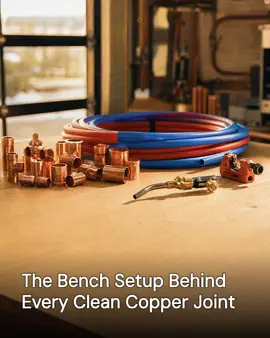
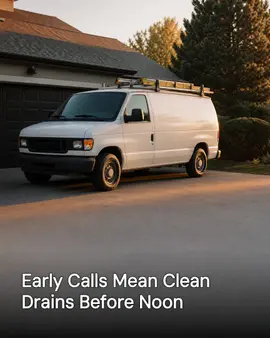
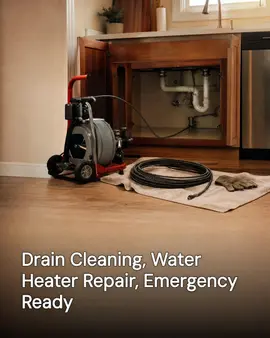
These three are the format above, finished. They were generated by SpeedRun Social for Copperline Plumbing, a demo brand we built ourselves to show a trade we have no customer in, and each card says so. The van at sunrise is the emergency post, the cable machine on the drop cloth is the drain post, the copper and PEX on the bench is the remodel post. The captions came from a brand kit rather than from a plumber, which is the difference between a starting point and the version only you could write.

Emergency: the 6am call, idea 15

Copperline Plumbing

Demo brand

Generated post: a plain white service van with a roof ladder rack parked in a residential driveway at golden hour, headline about early calls meaning clean drains before noon baked into the image

Copperline Plumbing Van's loaded and we're heading out before sunrise. Drain machine, water heater tools, leak detection kit, shop towels, drop cloths.

PlumbingGenerated

Drain: the slow kitchen line, idea 1

Copperline Plumbing

Demo brand

Generated post: a drain-cleaning cable machine and coiled cable resting on a towel in front of an opened kitchen sink cabinet with a small tray of tools laid out beside it, headline about drain cleaning, water heater repair and being emergency ready baked into the image

Copperline Plumbing Most people think drain cleaning is just about muscle and luck. Not really. It's about having the right machine staged, the cables prepped, everything laid out clean on a drop cloth before we even touch your sink.

PlumbingGenerated

Remodel: the rough-in on the bench, idea 10

Copperline Plumbing

Demo brand

Generated post: copper fittings, coiled red and blue PEX tubing, a brazing torch and a pipe cutter arranged on a wooden workbench in a plumbing shop, headline about the bench setup behind every clean copper joint baked into the image

Copperline Plumbing Copper fitting, PEX tubing, torch, pipe cutter, solder. All staged on the bench before the first joint gets heated. This is the setup that keeps water from leaking where it shouldn't be leaking.

PlumbingGenerated

Demo brand posts generated by SpeedRun Social. The free plan is 300 credits a month refilled forever, one free campaign a week (3 posts, 1 video, 1 cross-post), no card, watermarked media on free.

If you would rather not write fifteen captions

Every post on this page can be made by hand with a phone and the table above. If the caption is the part that never gets written, SpeedRun Social writes it from a brand kit, makes the image, and holds the post for your approval before anything goes out. The free plan is 300 credits a month refilled forever, one free campaign a week (3 posts, 1 video, 1 cross-post), no card, watermarked media on free.

Questions plumbers ask about social media

  • What should a plumbing company post on social media?

    The problems you fix, one per post, with the photo from the job and a caption that explains what went wrong: a slow drain, a failed water heater, a leak behind a wall, a rough-in on a remodel, a frozen line before the freeze. Add one crew post a week so there are people attached to the work, and one check-at-home item so the reader gets something to do. Skip the stock photos, holiday graphics and price lists; none of them show a homeowner you have solved their problem before.

  • Which social media is best for plumbers?

    Google Business Profile first, because it is attached to the search a homeowner actually makes, and a profile with recent job photos reads as open and busy. Facebook second, for the neighbourhood groups where a plumber gets recommended by name. Instagram third, mostly for recruiting and the crew and tool posts. TikTok and YouTube can work for a plumber who enjoys being on camera, but they are a second job, and none of the fifteen posts here need them.

  • How often should a plumber post on social media?

    Four times a week is what the table above is built around, and it is reachable because every weekly post comes from a photo you were already standing in front of. If four is not happening, two a week held for a year beats a burst of ten and then silence, because the profile has to look alive on the morning the water heater fails. Pick the number you can hold when the board is full in January.

  • Can I post photos of a customer's house?

    Post the work, not the house, and ask before you post either. A cabinet interior, an opened wall, a tank in a garage and a valve on a rag are fine when nothing in frame identifies the property: no house numbers, no mail, no faces, no street signs, no wide shot of a kitchen someone would recognise. For anything wider than the job itself, get a yes in writing first; a text message is enough.

  • What do I post when nothing interesting happened this week?

    Nothing interesting to you is the week's most useful post to a homeowner. A faucet swap, a flushed water heater, a replaced angle stop, a rubber hose swapped for braided: each is a problem someone reading has and does not know they have. Pull one from the tickets, take the photo on the next job like it, and write the caption from the phone call you had about it. If the camera really stayed in the pocket, the monthly rows in the table are made in the shop.

  • Does social media actually get a plumber jobs?

    Not the way an ad does, and anyone promising a number is guessing. What a feed built like this does is win the moment after the search: the homeowner has three plumbers open in three tabs, and the one whose page shows their exact problem, fixed, with a real photo and a plain explanation, gets the call. We have no data on how many calls that produces and will not invent any. The page with nothing on it never gets the benefit of the doubt.

  • Is it worth paying someone to run social media for a plumbing company?

    An agency can keep the schedule, but it cannot stand in the crawl space, so it drifts toward the stock photo unless you keep feeding it job photos, at which point you are doing the hard half anyway. The honest options: do the four posts yourself in under an hour a week using the table above, or use a tool that writes the caption and makes the image from your brand kit and lets you approve it. Ours runs the second way. The free plan is 300 credits a month refilled forever, one free campaign a week (3 posts, 1 video, 1 cross-post), no card, watermarked media on free. Paid plans are $49.99, $99.99 and $199.99 a month. Either way, the post with the photo you took on the job is the one that works.

Make the first three this week

By hand, from the truck, with the quick start at the top of this page. Or let the generator draft them and approve what you like.